You have spent decades getting good at things. Some of that skill came from a career, and some from a hobby that kept you engaged long after the workday ended. You can earn money online with either one, and neither requires you to become a different person or learn to code. It requires picking one skill, deciding who would pay for it, and setting up a few ordinary tools so that person can find you and pay you.
This article walks through how to monetize skills for seniors in a practical order: finding what is worth selling, choosing tools, studying a few business models, planning around the time you want to give, and launching a first paid offering.
Identifying the value in your hobbies
Most people undervalue what they know because it feels ordinary to them. If you can read a balance sheet, restore a wooden chair, coach a nervous public speaker, or plan a three-week trip through Portugal, other people find that difficult, and difficulty is what gets paid for.
Start with a written inventory instead of trying to decide in your head. Make three lists:

- What people ask you for. Neighbors, former colleagues, relatives, and friends who regularly come to you with the same kind of question are showing you a skill with demand.
- What you do without being paid. Hobbies that you would do anyway, such as gardening, genealogy, woodworking, quilting, photography or baking, often hold years of accumulated judgment.
- What your working life taught you. Think about the tasks you were trusted with, the problems colleagues brought to you, and the processes you could run without looking anything up.
Turn a skill into something a stranger would buy
A skill is not yet an offer. An offer names a person with a problem and describes the result you help them reach. “I know a lot about gardening” is a skill. “I help new vegetable gardeners plan a first-year bed so they harvest something in their first season” is an offer.
Run each candidate through three questions:
- Does someone have a problem this solves? Look for a situation where people feel stuck, rushed or unsure.
- Will they pay to solve it? Check whether people already pay for similar help, through books, courses, local classes or consultants. Existing payment is the best evidence of demand.
- Can you deliver it online? Video calls, written guides, recorded lessons, digital files and email support cover a wide range of work. If the skill needs your hands in a particular place, look for the part of it that can be taught or documented remotely.
Four ways skills usually become income
Most skills fit one of four forms, and knowing which one suits you quickly narrows your choices.
- Teaching: lessons, workshops or short courses delivered live or recorded.
- Doing: a service you perform for a client, such as bookkeeping, editing, proofreading, design, or research.
- Advising: one-to-one sessions where you review someone’s situation and tell them what you would do.
- Curating: finding, sorting, and recommending things, such as books, tools, travel options, or products, and earning through affiliate commissions or fees.
For example, a retired nurse administrator could teach families how to organize medical paperwork or advise small clinics on scheduling. Same background, two different offers. Choose the form that matches how you like to spend your days.
The tools that bridge the gap to monetization
The tool list for a first online income is shorter than most people expect. You need a way to be found, a way to talk to clients, a way to deliver the work, and a way to get paid. You can handle each with ordinary software.

A home base people can find
A simple website or a single well-written page gives people somewhere to go. It should say who you help, what you offer, how it works, and how to contact you. A blog on the same site lets you publish useful articles about your topic, which is how strangers searching for answers end up finding you.
If a full website feels like too much at first, a profile on a freelance or marketplace platform can be a good starting point. Our guide to the gig economy for seniors explains how those platforms work and what to look for before you sign up.
Communication and scheduling
Most service work happens over video call or email. A video conferencing tool, a business-only email address, and a scheduling tool that lets clients choose an open time slot cut down on most of the back-and-forth. Setting up a separate business email account keeps client messages separate from family mail, and our piece on creating and managing email accounts safely explains how to do that with sensible security settings.
If you will be meeting clients by video, practice the software with a friend before the first paid session. Our article on video conferencing tools for remote work covers the common options.
Delivering and storing your work
Clients will want to receive files such as a written guide, a set of photos, a spreadsheet, or a recording of your session. Cloud storage lets you share a link instead of attaching large files to an email, and it keeps a backup of your business documents if your computer fails.
For anything visual, such as a flyer, a cover for a guide, or a header for your website, a basic design tool is enough. You do not need professional software to produce a clean, readable layout. The article on basic graphic design tools for senior beginners is a good place to start.
Getting paid
You need a payment method clients trust. Established payment services let clients pay by card or bank transfer and send you a record of each transaction. Compare the fees each charges before you choose, since they differ, and keep a simple record of every payment you receive for tax time.
Protecting yourself while you work
Once your name and email are public, you will receive unsolicited messages, and some will be scams. Never share passwords, never send money to someone who claims you “overpaid” them, and treat urgent requests with suspicion. Our guides on online safety for seniors and on protecting seniors from online scams and fraud cover the habits worth building before your first client arrives.
If you are unsure whether you have the digital skills to set all this up, essential digital skills seniors need to make money online lists what to practice first.
Case studies of successful senior side hustles
The examples below are models, not reports of any individual’s earnings. Each shows how a particular background can be shaped into an offer. The same pattern applies to each: a body of knowledge, a specific audience, and an online delivery method that works.
The retired librarian who scouts books
A career spent around books builds a trained eye for which titles people want, which editions matter, and how to match readers with the right book. You can apply that knowledge to curating: reviewing and recommending books in a particular category and earning affiliate commissions when readers buy through your links. The audience is readers who want a trusted recommendation instead of an endless search results page. Our article on book scouting for Amazon affiliate profits describes this model in detail.
The lesson for your own situation is that a curator earns trust through specificity. A site covering “all books” competes with everyone, while a site covering, say, well-reviewed local history titles serves a narrow audience that has few alternatives.
The museum lover who hosts virtual tours
Someone with deep knowledge of a museum, a historic district, or an art collection can guide people through it live on video. The audience includes people who cannot travel, classroom teachers, retirement communities, and anyone planning a visit who wants context first. The work is teaching through a guided experience, and it depends on your ability to tell the story of what people are looking at. The article on virtual museum tour hosting and remote guide gigs explores how this kind of work is set up.
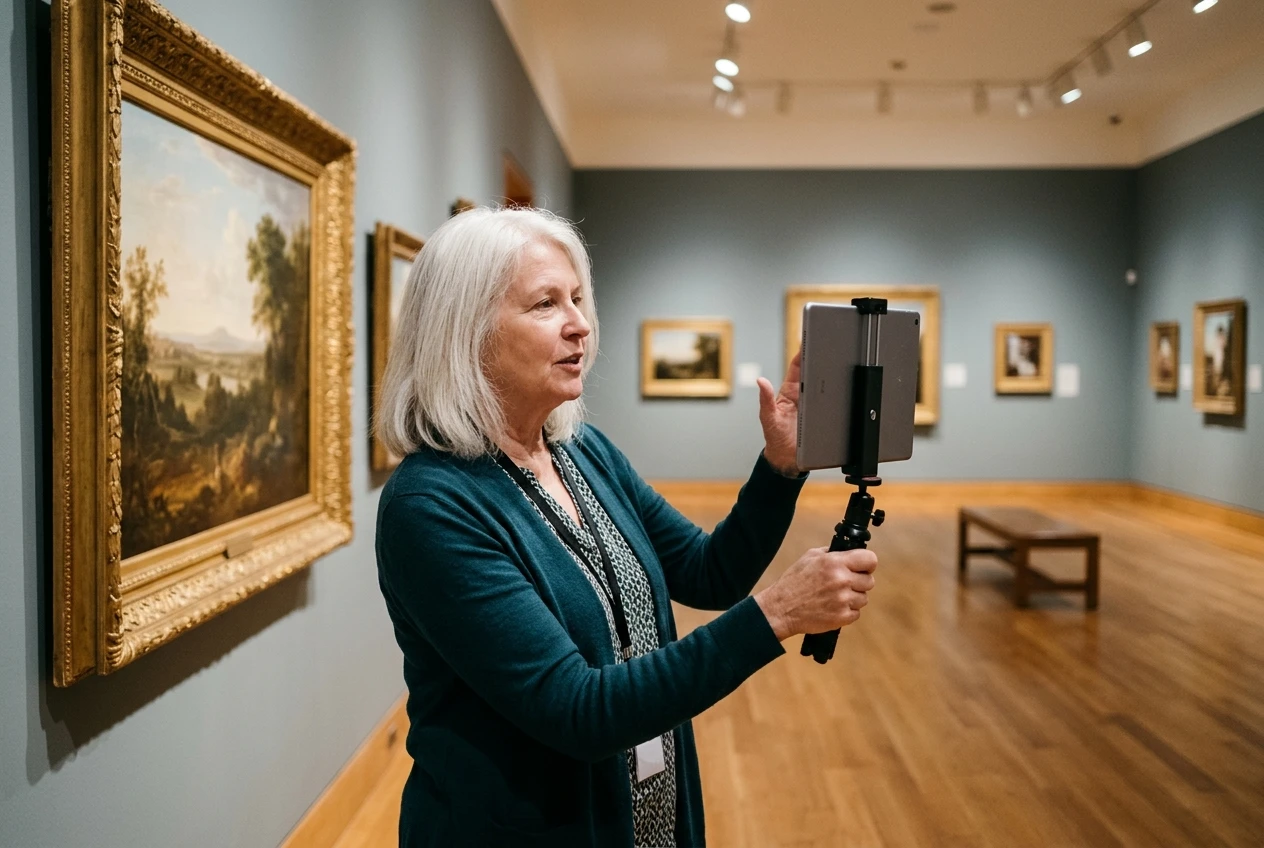
The transferable point is that expertise in a place or a subject can be sold as an experience, not only as information.
The silver-haired creator working with brands
Some seniors earn through social media by appearing in content for brands that want to reach an older audience, particularly in fashion, wellness, travel, and home products. This model leans more toward advising and promoting than teaching, and it depends on building a following that trusts your taste. Our piece on silver hair modeling and Instagram sponsorships covers it. If you are drawn to this path, learning to use social media for business covers the posting and profile basics.
This route usually takes the longest to produce income, because an audience has to exist before a brand will pay for access to it. It suits someone who enjoys regular posting more than one-to-one client work.

What the models have in common
Across these examples, the pattern is consistent:
- The offer is narrow enough that a buyer can tell at a glance whether it is for them.
- The seller’s experience is the reason to trust them, so they state it plainly on the site or profile.
- You can do the work from home, on a schedule the seller controls.
- Income grows from repeated delivery to a defined audience, so patience and consistency matter more than any single big launch.
Building a business plan around your time
A side-income plan doesn’t need to be a thick document. One page covering your hours, your price, your first customers, and your costs is enough to make decisions with. Hours come first because they limit everything else.
Decide how many hours you really want to work
Be realistic about the week you actually live. Appointments, family, travel, volunteering, and rest all take time, and the business has to fit around them. Write down how many hours you can give each week without resenting it. Then decide which hours: mornings when your energy is highest, or two fixed afternoons, so that the work has a shape.

A small, steady number of hours is a perfectly good plan. Six hours a week kept up for a year produces far more than a burst of effort that stops after a month.
Price by the value of the result and the time it takes
Work out what you need to earn for your time to feel worthwhile, then check it against what others charge for similar help. Search for people offering comparable services and read their published prices. Do not set your price by guessing what you are “worth”; set it by what the market pays and what the result is worth to the client.
Here is a simple illustration of the arithmetic, using made-up numbers. If you offer one-hour advisory sessions and each session also needs thirty minutes of preparation and follow-up, each session takes ninety minutes of your week. Six available hours would then fit four sessions. Whatever you decide to charge per session, multiply by four to see the weekly ceiling, and decide whether that matches what you want from the work. Pricing a session at only the cost of an hour, and forgetting preparation, is the most common way new service providers underpay themselves.
Count the costs and the paperwork
List what the business will cost: a website address and hosting, a scheduling or video tool if you pay for one, payment fees, and any software. Most of these are small recurring amounts, and writing them down means you know your real profit.
Extra income can affect your taxes and, in some cases, the benefits you receive. Rules vary by country and personal situation, so speak with a qualified tax adviser or your local benefits office before your income begins, and keep a record of every payment received and every business expense.
Set a simple review point
Choose a date three months after launch to look at what happened: how many clients you served, how many hours it took, what you earned, and which part of the work you enjoyed most. Adjust the offer based on those facts. If one kind of client was easy to work with and another was exhausting, narrow your offer toward the easy ones.
How to launch your first service offering
A first offering should be small, clearly described, and quick to deliver. The goal is to complete your first paid job, since it teaches you more about your business than any amount of planning.
Step 1: Write the offer in two sentences
Name the person you help, the problem, and the result. For example: “I help people over fifty set up a household budget in a spreadsheet they can keep using. In one session, we build it together on a video call.” If you cannot describe it in two sentences, it is still too broad.
Step 2: Set the scope and the price
Decide exactly what is included, how long it takes, and what it costs. A fixed price for a defined result is easier for a new client to say yes to than an open-ended hourly rate. State what is not included, so the boundaries are clear before work begins.
Step 3: Prepare the minimum tools
Before you tell anyone about it, make sure the following are in place:
- A page or profile that describes the offer, shows who you are, and explains how to book.
- A business email address.
- A way to schedule and take payment.
- A cloud storage folder for each client’s files, with sharing set to private.
Step 4: Find your first clients where you already have trust
Your first buyers are most likely to come from people who already know you: former colleagues, members of clubs and groups you belong to, and online communities where you have contributed. Tell them plainly what you are offering and who it suits. A short, direct message works better than a broad announcement.

You can also offer your first one or two sessions at a reduced price in exchange for an honest testimonial and permission to quote it. Be open about this arrangement, and do it only for a small number of clients.
Step 5: Deliver, then ask for feedback
Do the work carefully, keep to the time you promised, and send any follow-up material the next day. Afterward, ask the client two questions: what was most useful, and what would they change. Their answers will tell you what to keep, what to cut, and how to describe the offer more accurately on your page.
Step 6: Publish what you know
Each client question is a possible article. If three people ask you how to organize digital photos or how to read a pension statement, write a clear guide to it and put it on your site. Over time, these articles attract people searching for exactly that help, so you don’t have to chase new clients as much.
Step 7: Repeat, then raise your standards and your price
After a handful of completed jobs, you will know how long the work really takes, which clients suit you, and what to charge. Raise your price when your calendar is consistently full, and use the testimonials you have gathered to support the higher figure.
Where to go from here
The path from hobbyist to earner is made of small, ordinary decisions: choosing one skill, describing it as a result someone wants, setting up a few reliable tools, and completing a first paid job. None of them depends on age, and your background is the main advantage you bring to each one.
If you would like to see another model of how a hobby becomes an income stream, read our post on drone photography as a side hustle.
This article was created with AI assistance and reviewed by a human editor.